
Due Diligence in International Law: the Environment, Human Rights and Cybersecurity
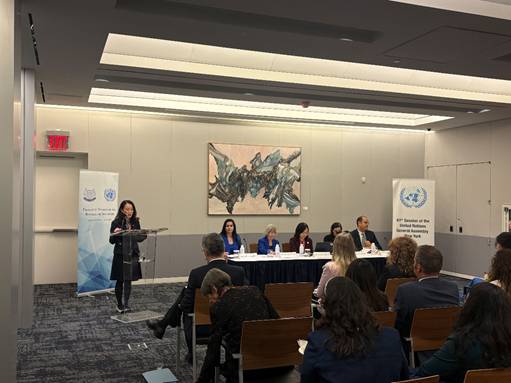
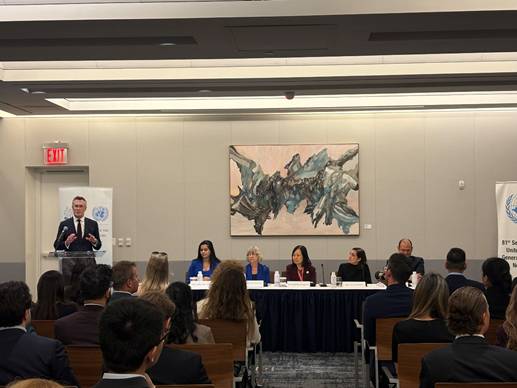
On 27 October 2026, an audience of government legal advisers, other international law practitioners and academics attended the 11th annual Freshfields’ Public International Law Seminar.
This year, the Seminar was hosted by the Permanent Mission of Singapore to the United Nations, following a brief introduction by Karen Ong (Deputy Permanent Representative of the Permanent Mission of Singapore to the United Nations) and Will Thomas KC (Partner and Head of Public International Law, Freshfields).
The topic of this year’s seminar was “Due Diligence in International Law: the Environment, Human Rights and Cybersecurity.”
Anika Havaldar (Senior Associate, Freshfields) moderated a panel comprised of Daphne Hong SC (Solicitor-General of Singapore), Penelope Ridings (Member, UN International Law Commission; Special Rapporteur on Due Diligence in International Law), Mohamed Helal (Professor of Law, Moritz College of Law, The Ohio State University) and Lucía Solano (Legal Advisor, Permanent Mission of Colombia to the United Nations).
Over the course of an hour-long discussion, the speakers explored the legal character, scope and content of due diligence in international law, focusing on its application to transboundary environmental harm and climate change, the protection of human rights, and cyber operations. The speakers addressed several areas, including:
- Work of the International Law Commission: why the Commission considered due diligence ripe for codification; the core questions of legal character, scope and content identified in the Special Rapporteur’s first report; and how States view the Commission’s work on the topic.
- Character of the obligation: whether due diligence is best understood as a general principle of international law, or as a variable standard of conduct attached to particular primary rules; whether those two conceptions are mutually exclusive; and whether this distinction is a useful lens at all.
- Practical challenges: the challenges States face in operationalizing due diligence obligations across different areas of international law; how duties traditionally regarded as procedural, such as prior notification and consultation, fit within these obligations; and whether the distinction between procedural and substantive obligations is meaningful in the context of due diligence.
- Climate change and a variable standard: whether the recent climate change advisory opinions from the International Court of Justice, the International Tribunal for the Law of the Sea, and the Inter-American Court of Human Rights signal a stricter standard for due diligence in other areas of international law.
- Coherence across areas: how greater clarity on the scope and content of the due diligence obligation might benefit States and other international actors; how the obligation interacts with related obligations such as the duty to cooperate; and whether a coherent approach to due diligence can emerge across fields as different as the environment, human rights, and cyberspace.
Freshfields’ Public International Law Seminar is held every year as a side event of the Sixth Committee (Legal) of the United Nations General Assembly.
To learn more about Freshfields' public international law practice, please click here.