

Climate Change, Human Rights, and Investor-State Arbitration: Rethinking Compensation in International Law
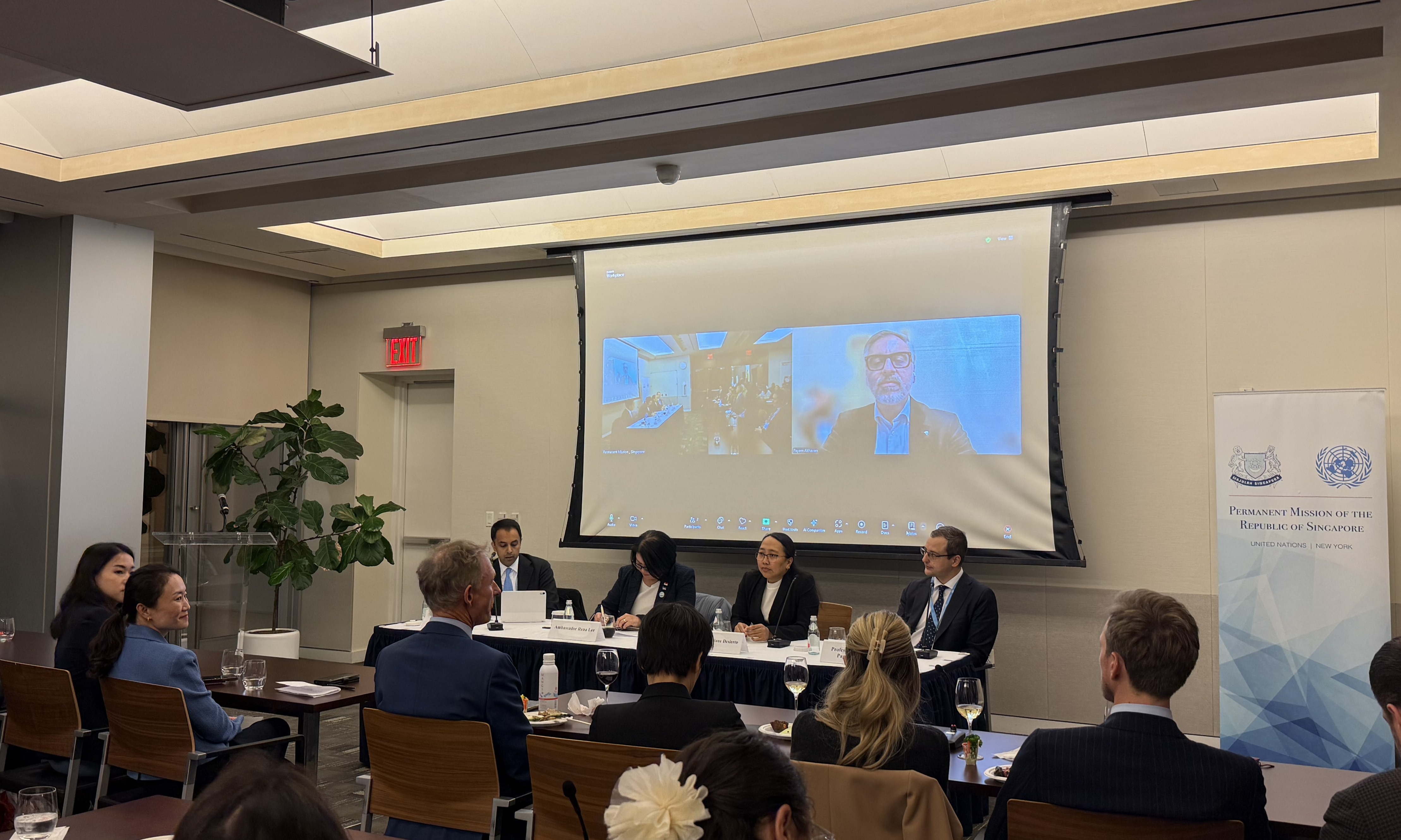
On 28 October 2025, an audience of close to 80 government legal advisers, other international law practitioners and academics attended the annual Freshfields' Public International Law Seminar, celebrating the Seminar's 10th anniversary.
This year, the Seminar was hosted by the Permanent Mission of Singapore to the United Nations, following a brief introduction by Karen Ong (Deputy Permanent Representative of the Permanent Mission of Singapore to the United Nations) and Will Thomas KC (Partner and Head of Public International Law, Freshfields).
The topic of this year’s seminar was: “Climate Change, Human Rights and Investor-State Arbitration: Rethinking Compensation in International Law.”
Joshua Kelly (Partner, Freshfields) moderated a panel comprised of Ambassador Rena Lee (Singapore’s Ambassador for International Law and candidate for election to the ICJ), Professor Payam Akhavan (Barrister, Twenty Essex Street Chambers; Chair in Human Rights, Massey College, University of Toronto), Professor Diane Desierto (Professor of Law and Global Affairs, University of Notre Dame) and Professor Martins Paparinskis (Professor of Public International Law, UCL; incoming Chair, UN International Law Commission)
Over the course of an hour-long discussion, the speakers explored the evolving landscape of compensation under international law, focusing on its application to the fields of climate change, human rights, and investor-State arbitration. The speakers addressed several areas, including:
- The principle of full reparation: How the foundational standard set by the Factory at Chorzów case and codified in the ILC Articles on State Responsibility continues to shape debates on compensation for internationally wrongful acts.
- Causation: The complexities of establishing causation, especially in cases involving environmental harm, and how international courts and tribunals have approached these challenges.
- Quantification of damages: The difficulties in assessing compensation for climate-related and other complex harms, including the appropriateness of awarding global sums.
- Equitable considerations: Whether and how equity should influence the determination of compensation, including in climate change, investor-State and human rights contexts.
- Compliance with compensation awards: Trends in compliance, particularly in the human rights sphere, and what this means for the future of compensation under international law.
- New mechanisms for compensation: The emergence of innovative frameworks such as Ukraine’s Register of Damage and the climate change-specific Loss and Damage Fund, and their potential as models for addressing large-scale harm.
Freshfields' Public International Law Seminar is held every year as a side event of the Sixth Committee (Legal) of the United Nations General Assembly.
To learn more about Freshfields’ public international law practice, please click here.


