
The drone dilemma: Turning innovation into lasting defense capability
The pace of drone innovation is exposing a difficult mismatch: technology can change in weeks, while the systems that finance, procure and manufacture it often move in years. For Europe, building lasting defense capability will depend on closing that gap – without sacrificing resilience, security or the traditional capabilities that remain essential.
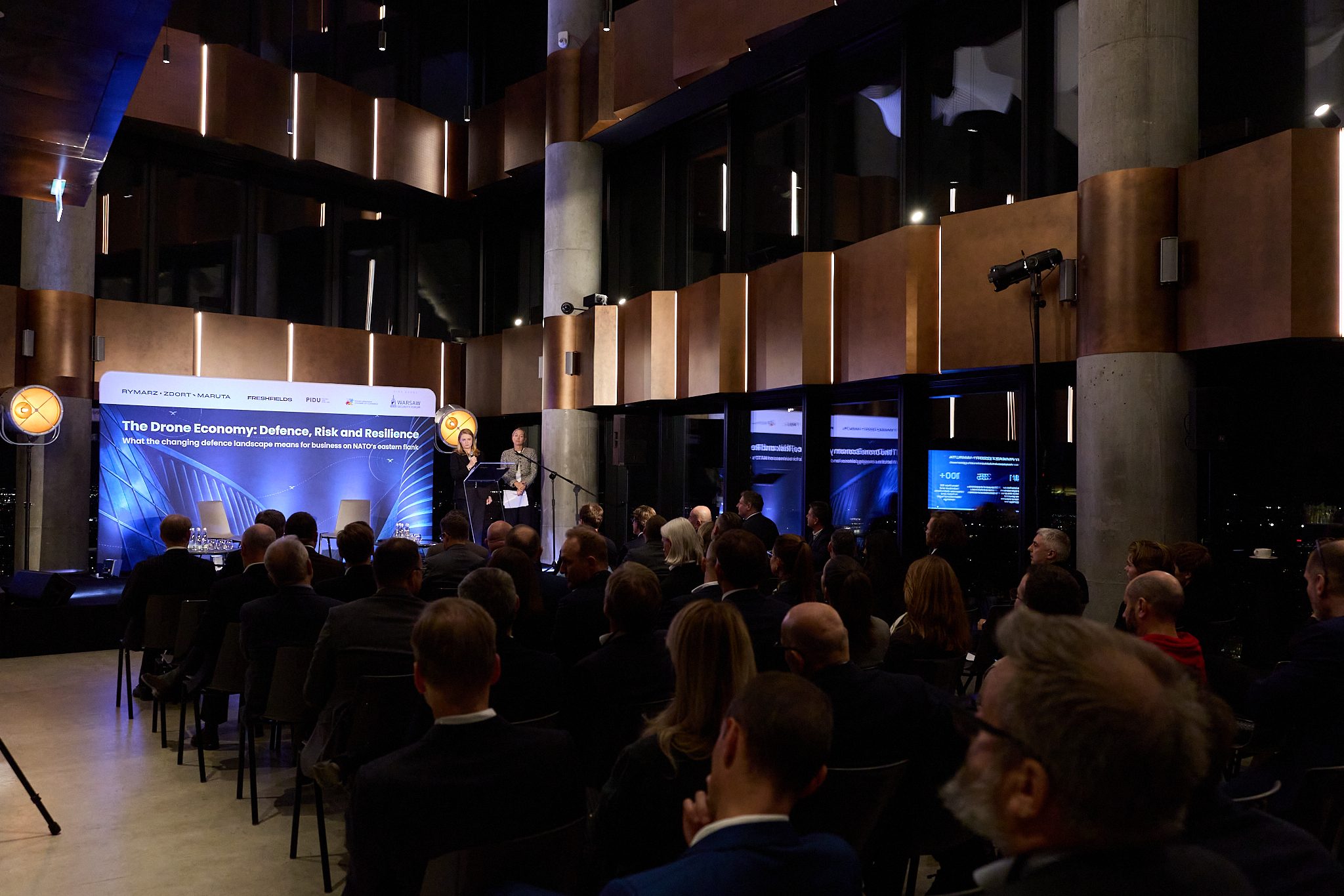
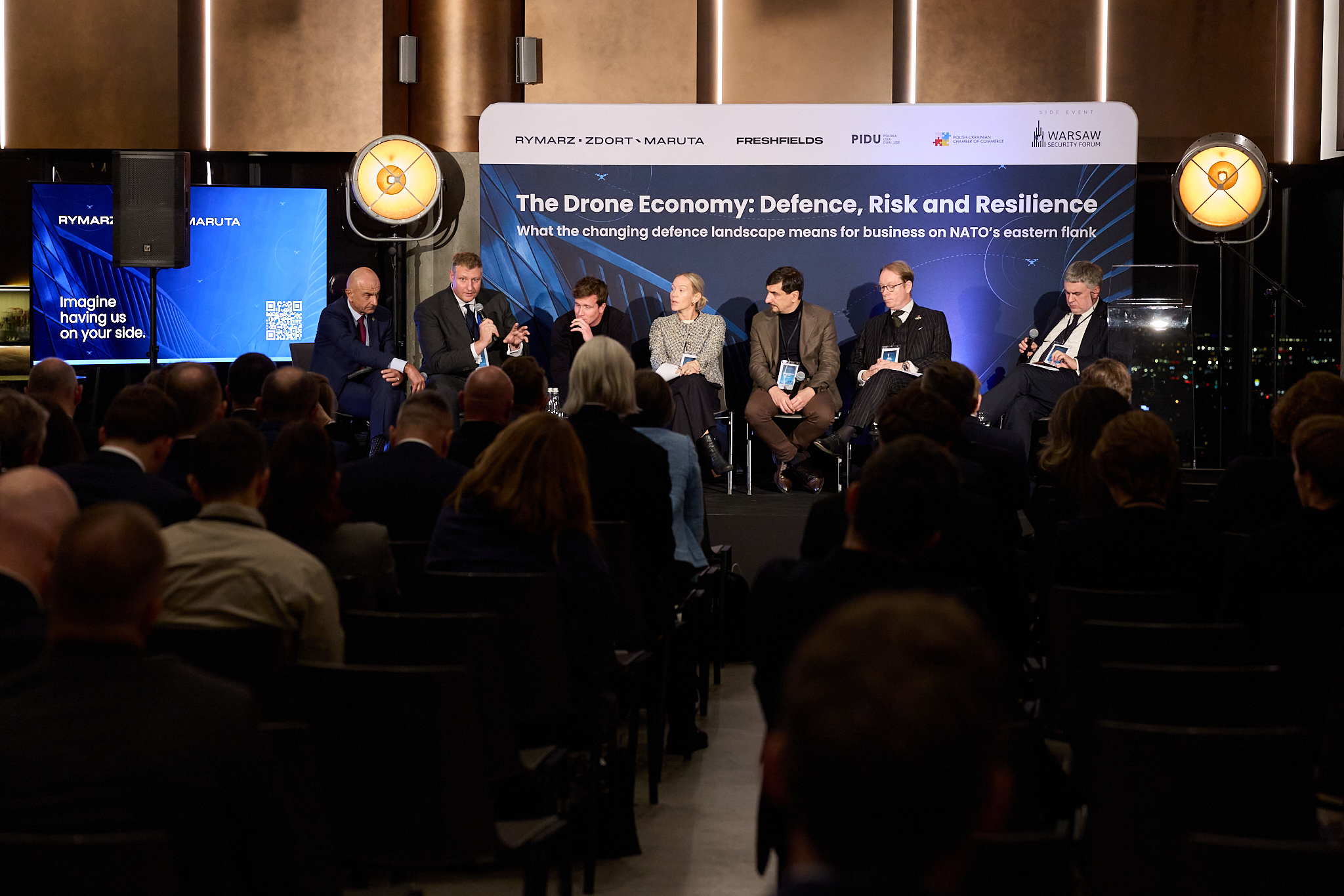
That challenge was at the heart of “The Drone Economy: Defense, Risk and Resilience,” a panel discussion hosted by Freshfields and our StrongerTogether partner firm Rymarz Zdort Maruta at the Warsaw Security Forum 2026.
Three questions drove the debate:
- Is the war in Ukraine really a drone war, or is it best understood as conventional warfare transformed by drone technology?
- How should Western governments and industry approach drone production and readiness?
- Where is drone technology heading, and how resilient are the AI systems, data links and supply chains that adversaries are likely to target?
Bringing together perspectives from the military, government, technology, investment and law, the discussion explored the practical challenges facing Europe's governments, businesses and investors.
Innovation is outpacing procurement
Unmanned systems are now among the most visible symbols of the war in Ukraine. Yet thousands of 155mm artillery shells are still fired every week. Drones have transformed how armed forces find, track and strike targets – but they have not replaced the need for mass, depth and endurance. The panel's conclusion was that balance matters: investing in new technology without hollowing out traditional capabilities. Since Russian drones entered Polish airspace in September 2025, that balance is no longer a theoretical debate for NATO’s eastern flank.
“This is not simply a drone war; war is fundamentally a political act. Drones are tools of warfare, but they cannot replace political strategy, industrial capacity, alliances and the broader objectives that ultimately determine how a war is fought and won.” General (ret.) Rajmund T. Andrzejczak
Innovation cycles measured in weeks collide with procurement cycles measured in years. Traditional procurement often buys a defined product against a fixed specification; drone warfare rewards constant iteration. Many governments are testing faster routes instead: framework agreements, innovation partnerships and competitions with rapid follow-on contracts. Europe’s efforts to streamline defense procurement, including the recently adopted Defence Readiness Omnibus package, point the same direction – but the real test will be how contracting authorities and suppliers translate regulatory changes into faster delivery.
“A drone is a flying part of a much larger system. Its value depends on whether the information reaches the right person, whether that person can trust it, and whether the next aircraft and trained operator are available when needed. My German position is straightforward: deploy and learn now; pay for production readiness; make suppliers interoperable; and retain control over the data, software and decisions. We should combine Ukrainian experience with German industrial execution and European scale.” Dr Yorck Hesselbarth
Building capacity without creating new dependencies
Paying for capacity rather than output takes new models: capacity reservation contracts, availability payments, multi-year offtake commitments and joint procurement across states. European instruments such as the Security Action for Europe, designed to accelerate defense readiness and the European Defence Industry Programme, aimed at achieving the long-term defense industry preparedness, add firepower, and national defense budgets continue to rise. For governments and industry alike, the challenge will be to invest with enough certainty to create capacity – and enough flexibility to respond as technology and political priorities change.
Scale depends on supply chains, too. Many of the motors, batteries, magnets and sensors in today’s drones come from China, which has already restricted exports of certain components. Building European capacity means mapping supply chains down to component level – and navigating export controls, dual-use rules, foreign investment screening and origin requirements along the way. Companies that get ahead of these rules can turn compliance into a competitive edge.
Resilience extends beyond the battlefield
Electronic warfare is already reshaping drone design. AI-supported navigation and target recognition and emerging coordinated swarms could reduce reliance on vulnerable data links. But they also raise hard questions about human control, international humanitarian law and accountability. Connected systems also create cybersecurity vulnerabilities. Cyber resilience is becoming a design requirement, and increasingly a contractual one, alongside clear rules on software updates, data and intellectual property.
In 2025, drone sightings grounded flights across European airports and exposed gaps in critical infrastructure protection. Airport, energy and port operators now face hard practical questions: who may detect and neutralize a drone, who is liable for the damage, and what risks can realistically be insured? Counter-drone systems are becoming a growth market in their own right – one that demands close coordination between states, regulators and private operators across borders.
“We need to understand not only the drone economy, but also traditional military materiel, industrial capacity and the security of information. The future of warfare depends on combining technological innovation with conventional capabilities, while ensuring that information security is embedded throughout the entire defence ecosystem.” Kate Gough
From innovation to lasting capability
What connects these challenges is the need to turn rapid battlefield innovation into lasting industrial readiness. For European governments, that means matching fast-moving technology with procurement, investment and regulatory systems that can evolve alongside it. For businesses and investors, it means recognizing that resilience – of supply chains, systems and production capacity – is becoming as important as technological capability itself.
About the discussion
The panel brought together senior figures from the military, government, defense technology, investment and law:
General (ret.) Rajmund T. Andrzejczak, former Chief of the General Staff of the Polish Armed Forces
Tobias Billström, Chief Governmental Relations and Compliance at Nordic Air Defence and former Swedish Minister for Foreign Affairs
Dr Yorck Hesselbarth, co-founder of Orcrist Technologies and former AI Lead Officer at the Bundeswehr Cyber Innovation Hub
Stanisław Kastory, co-founder of Expeditions Fund
Andrew Biletskyi, entrepreneur and co-founder of Fortes Aero
Kate Gough, Freshfields Partner and Head of UK Public Procurement
The discussion was moderated by Witold Jurasz, journalist with Onet.pl and former diplomat.
This event continued our geopolitical conversations at the Warsaw Security Forum, following last year’s panel on geopolitical risk, investment and resilience in Central and Eastern Europe and our Munich Security Conference discussion on defense, technology and private capital earlier this year.
For more on aerospace and defense, procurement, export controls and geopolitical risk, visit our Aerospace and defense page.