

Treasury’s COINS Act Proposed Rule: Key Changes from the Current Outbound Investment Program
On October 22, 2026, the U.S. Department of the Treasury released its proposed rule implementing the Comprehensive Outbound Investment National Security (“COINS”) Act, enacted last December as part of the Fiscal Year 2026 National Defense Authorization Act (“NDAA”). The proposal would replace the current Outbound Investment Security Program (“OISP”) regulations, in effect since January 2, 2025, with the new regulations promulgated under the NDAA rather than the International Emergency Economic Powers Act (“IEEPA”). The statutory deadline for the final rule is March 13, 2027.
I. Key Changes
- Country of Concern expansion with likely minimal-to-no impact: Expands scope of countries of concern beyond China (including Hong Kong and Macao) to include Iran, North Korea, Russia, Cuba, and Venezuela (under the regime of Maduro, which the proposal’s preamble indicates no longer exists).
- Significant technology expansion:
- Biotechnology (including pharmaceutical compounds) would be a prohibited technology and hypersonic systems would be added as notifiable or prohibited technologies.
- Development of any AI system (now coined “Super Intelligence”)—with limited exceptions for internal, non-commercial usage—would be a prohibited technology, without regard to end-use or computational power required to train the system.
- Expansion of restrictions on U.S. employees of foreign companies: U.S. persons in decision-making roles at foreign companies would have to notify Treasury notifiable transactions they knowingly direct, and not just refrain from knowingly directing prohibited transactions.
- Broader definition of covered foreign person: Entities subject to the “direction or control” of private persons of a country of concern could be covered foreign persons even without 50 percent ownership. However, the proposed rule does not define either direction or control.
- Clarification of exceptions:
- Ancillary transactions such as underwriting IPOs, processing and clearing payments, and other similar services would be expressly excepted.
- Licensing agreements are excluded by implication, but, in practice, governance, co-development/co-commercialization structures, and profit-sharing arrangements potentially could bring license & collaboration deals back within scope as a form of joint venture, even in the absence of a newly formed entity.
II. Key action points
- In-flight deals. Companies with in-flight deals that may close after the final rule takes effect (potentially as early as March 2027) should evaluate their transaction under the proposed rule now. The proposal does not grandfather signed but unclosed transactions, so parties should consider closing conditions, termination rights and closing representations that address both the current and proposed rules.
- Biotechnology and pharmaceutical companies should assess their transaction structures with Chinese counterparties, particularly licensing and co-development, to determine whether such arrangements may be considered joint ventures or another form of covered national security transaction under the proposed rule.
- Follow-on investments. Investors should revisit prior conclusions that a portfolio company or pipeline target was "not covered" or merely notifiable before making any follow-on, additional tranche or new investment, particularly in AI, semiconductors (including photonics and compound semiconductors), quantum software, biotech, and hypersonics.
- Counterparty screening. Investors should update counterparty screening to capture contractual and minority control rights held by country of concern persons, not just ownership thresholds, to assess if the target or JV partner is a covered foreign person.
- U.S. persons at non-U.S. funds and companies. Non-U.S. funds and companies with U.S. officers, directors, or investment committee members should put formal recusal protocols in place before the effective date.
- Seeking Treasury guidance. Investors should consider how they would use the proposed non-binding feedback process, which would allow a party to an actual transaction (with material terms set out in a binding document) to ask Treasury whether it would be prohibited, for borderline deals once the final rule takes effect. Investors should also ask the target and co-investors whether they have received any communication from Treasury about the target.
- Comments on the proposed rule are due by December 7, 2026.
III. Overview of Key Changes
Much of the substance of the rules remains the same, including the two-tiered system of notifiable and prohibited transactions, the knowledge standard, the 30-day post-closing filing requirement for notifiable transactions, and most existing exceptions. However, the proposal would considerably expand the program's reach, and significantly expand the technology scope, most significantly to include biotechnology and prohibit investments in companies that develop artificial intelligence (now referred to as “Super Intelligence” or “SI”) that today are not within scope of the OISP or only require notification. It would also extend the ‘knowingly directing’ concept to notifiable transactions, a consequential change for U.S. persons at non-U.S. funds and companies. It also offers relief for financial services providers and a way to obtain Treasury’s views on the application of the rule to specific deals.
- Notifiable and prohibited technologies would expand, including to prohibit most AI and biotechnology (broadly defined to include pharmaceutical compounds) investments.
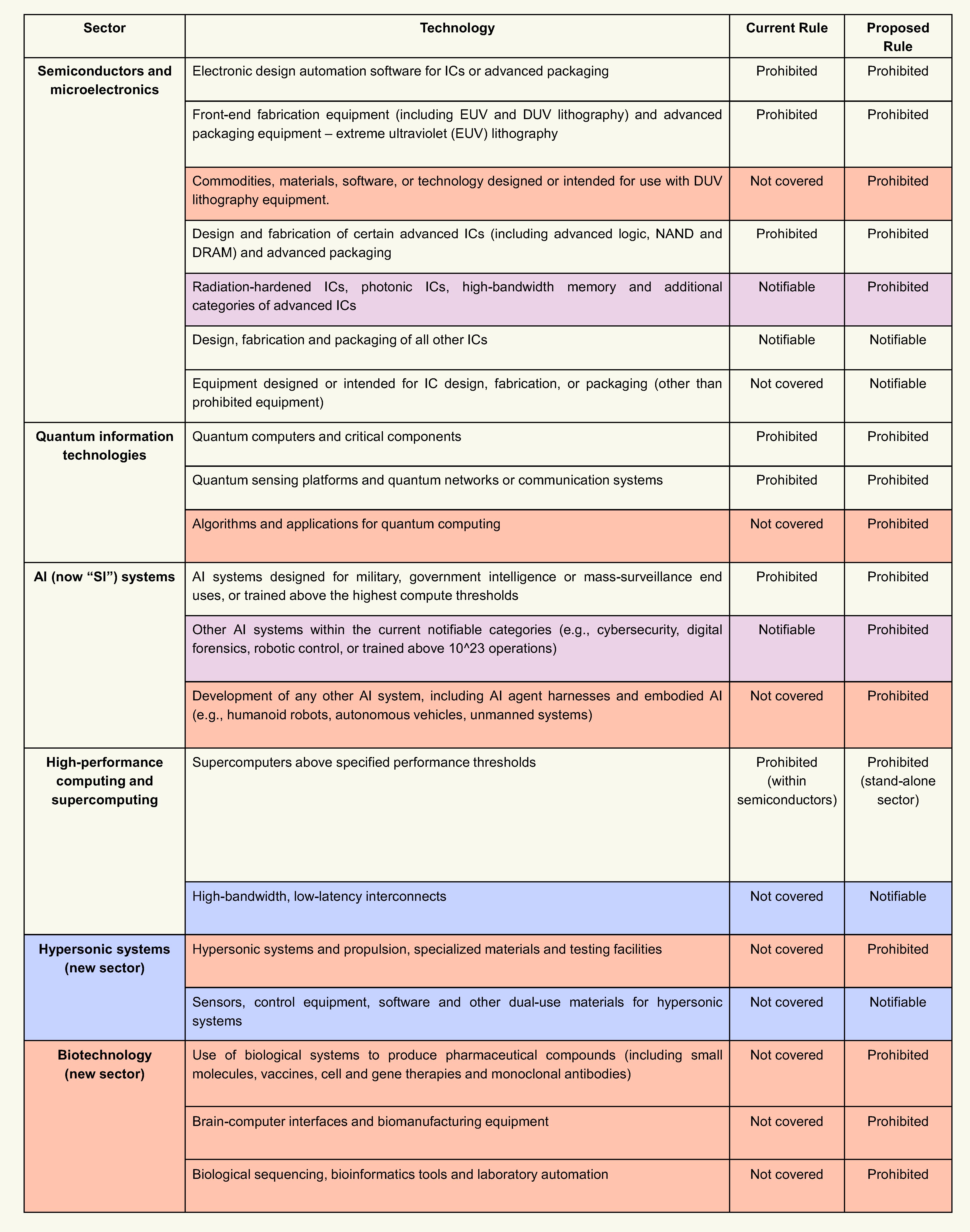
- Artificial Intelligence: Covered transactions involving AI (now “SI”) systems would move from notification to outright prohibition.
- Current Rule: Many covered transactions involving a covered foreign person that develops an AI system are notifiable, meaning they merely require a pre- or post- closing filing with Treasury. Only transactions involving a covered foreign person that develops AI systems designed for military, government intelligence or mass-surveillance end uses, or trained above specified compute thresholds, are prohibited.
- Proposed Rule: The proposed rule instead treats the development of any SI system as a prohibited technology, with Treasury arguing that training compute is no longer a reliable proxy for capability. The proposed definition of SI system captures any software that operates in whole or in part using an SI model, including a third-party model. A covered foreign person that builds on a third-party model is treated as developing an SI system when its software enhances or extends the capability of that model (e.g., an agentic harness).
- Takeaway: Based on our experience, this new definition would likely capture most SI companies. A carve-out remains for off-the-shelf third-party SI systems used for internal, non-commercial purposes, but commercial fine-tuning or deployment is not excepted. These changes would result in transactions that are not even notifiable under the current rule being prohibited.
- Biotechnology: Biotechnology (broadly defined to include pharmaceutical compounds) would be a prohibited technology.
- Current Rule: Biotechnology is not a covered technology. The current rules reach biotechnology only through the prohibition on AI systems trained primarily on biological sequence data above a specified compute threshold.
- Proposed Rule: Treasury adds biotechnology pursuant to its authority to designate technologies beyond those named in the statute, with all covered biotechnology activities being prohibited. These would include technologies such as the following:
- Development, engineering, or use of a biological system, or a component of a biological system, to modify, enhance, produce or control pharmaceutical compounds, energetic precursors or materials, and biofuels, among others.
- The proposed rule does not define “biological system.”
- “Pharmaceutical compounds” expressly identifies small molecules, polymers, vaccines, blood and blood components, allergenics, cell and gene therapies, monoclonal antibodies, and other recombinant therapeutic proteins.
- Brain-computer interfaces
- Biomanufacturing equipment
- Biological sequencing technology
- Bioinformatics tools
- Laboratory automation
- Development, engineering, or use of a biological system, or a component of a biological system, to modify, enhance, produce or control pharmaceutical compounds, energetic precursors or materials, and biofuels, among others.
- Takeaway:
- Investors in life sciences should reassess their pipelines and transaction structures.
- The biotechnology definitions could reach a large share of equity investments in Chinese biopharma companies. The main prohibition turns on the use of a “biological system,” a term the proposal does not define. Treasury has asked for comment on whether to describe biological systems more precisely, to limit “pharmaceutical compounds” to advanced or frontier technologies, or to focus the prohibition on activities undertaken using certain biomanufacturing and laboratory equipment.
- In addition, while licenses, on their own, are not a covered national security transaction, the breadth of “joint ventures”, in which a new entity need not be created, could arguably ensnare certain transaction structures typically seen in licensing deals, especially if there is a profit/loss share, co-development or co-commercialization under a governance committee, or a joint contribution of assets.
- Other Technologies: Other notifiable and prohibited technologies would expand, including the addition of hypersonic systems.
- Current Rule: The current rules cover technologies related to semiconductors and microelectronics, quantum information technologies, and AI. Supercomputers are addressed only through a prohibition within the semiconductor technologies.
- Proposed Rule:
- Semiconductor technologies would be expanded to cover:
- new prohibited technologies, including radiation-hardened integrated circuits, photonic integrated circuits (including the development of optical components and co-packaged optics) and high-bandwidth memory; and
- commodities, materials, software, and technology for lithography equipment, with the prohibition extending beyond such items designed exclusively for extreme ultraviolet (EUV) tools to items designed or intended for use with either deep ultraviolet (DUV) or EUV tools.
- Development of quantum algorithms and applications would become a prohibited technology.
- High-performance computing and supercomputing technologies remain prohibited, and technologies involved in high-bandwidth, low-latency interconnects for high performance computing become notifiable. Because the category is not limited to integrated circuits, it could reach optical and other interconnect components used in data centers.
- Hypersonic system technologies are newly added to both notifiable and prohibited technologies.
- Semiconductor technologies would be expanded to cover:
- Takeaway: Investors in the advanced manufacturing, quantum, and computing spaces should carefully evaluate planned transactions and factor-in the new rules when conducting diligence and risk analyses in future deals.
- Artificial Intelligence: Covered transactions involving AI (now “SI”) systems would move from notification to outright prohibition.
- The definition of “covered foreign person” would reach more entities through a broadened control test.
- Current Rule: The current rules treat an entity as a person of a country of concern if it is owned 50 percent or more by persons of a country of concern, but apply a control test only to entities controlled by the government of a country of concern.
- Proposed Rule: The control test would extend to any entity whose management or policies a country of concern individual or entity can direct, through voting securities, contract or otherwise. No minimum ownership is required, and the level of control needed is unclear (for example, whether veto rights suffice).
- Takeaway: Investors should not rely on ownership thresholds alone when screening counterparties, and should consider whether country of concern persons hold contractual or minority rights.
- “Knowingly directing” would extend to notifiable transactions, with significant implications for U.S. persons serving as officers or directors of non-U.S. entities.
- Current Rule: The current rules prohibit a U.S. person from knowingly directing a transaction by a non-U.S. person only where the transaction would be a prohibited transaction if a U.S. person engaged in it.
- Proposed Rule: Because the COINS Act incorporates “knowingly directing” into the definition of a covered national security transaction, the concept now extends to notifiable transactions (other than an acquisition of a limited partner interest or equivalent in a pooled investment fund that is not a U.S. person). The “knowingly directed” test, however, is substantively unchanged: a U.S. person directs a transaction where they have authority to make or substantially participate in decisions on behalf of a foreign person, including as an officer, director or holder of executive responsibilities, and exercise that authority to direct, order, decide upon or approve the transaction. A U.S. person who directs a notifiable transaction would have their own notification obligation, unless they recuse themselves from the approval and decision-making process, the transaction documents, and the negotiations.
- Takeaway: Non-U.S. companies should consider implementing formal recusal processes for U.S. person decision-makers in executive roles and on their boards and investment committees.
- New exceptions would benefit underwriting and potentially bank loans but offer other investors little new relief.
- Current Rule: Transactions are notifiable or prohibited regardless of value, and an underwriter’s acquisition of shares (even temporarily) of an issuer can be a covered transaction, subject to exceptions for, among others, (1) publicly traded securities, (2) securities of registered investment companies and business development companies, and (3) limited partner investments with committed capital of $2 million or less or with a binding contractual assurance that the investor’s funds will not be used for transaction that would be prohibited or notifiable if undertaken by a U.S. person. The guidance provided that ancillary transactions generally were not covered.
- Proposed Rule: The categories of covered national security transaction and the core excepted transactions are largely unchanged, with the most significant change being that temporary ownership of issuer’s shares would not cause underwriting to be a covered transaction. However, the proposed rule provides no further guidance for U.S. investors subscribing in an IPO of a covered foreign person, whose eligibility for the publicly traded securities exception continues to depend on when the shares are considered to have been “acquired” (a term the rules do not define) relative to the start of trading. Bank lending is excepted, without the current rule’s qualification for loans carrying equity-like rights, although Treasury has asked whether it should except all bank lending. Beyond this, the proposed rule also largely codifies the previous guidance that transactions secondary or ancillary to a covered national security transaction are excepted. A new $50,000 de minimis exception would also apply to transactions that would otherwise be notifiable, but not to prohibited transactions. However, the exception for business development company securities is absent, although Treasury has asked whether it should be restored.
- Takeaway: Underwriters and potentially banks will benefit from the new exception and should update their existing compliance procedures accordingly. For funds and other investors, the existing exceptions will be largely, though not entirely, unchanged.
- Treasury would expand the ways it takes in information and provides guidance, and would expect U.S. persons to take that guidance into account.
- Current Rule: There is no formal advisory opinion process. National interest exemptions are available.
- Proposed Rule: The proposed rule broadens the ways Treasury can gather information and share its views with investors:
- Feedback: A person with a direct financial interest in an actual, prospective transaction could request non-binding feedback on whether it would be a prohibited transaction. Treasury need not respond, but it may give confidential written feedback to the requester or issue anonymized public guidance, such as FAQs.
- Notifications: Treasury may follow up on a filed notification and, in doing so, share its own information or views on the covered foreign person involved.
- Outreach: Treasury monitors the market for transactions that may be prohibited or were not notified, and may contact the parties based on what it finds.
- Database and public submissions: Treasury is considering, but has not decided, whether to publish a non-exhaustive public database of covered foreign persons. Separately, anyone could submit information confidentially (though not anonymously) on whether a foreign person is a covered foreign person engaged in a prohibited or notifiable technology. Those submissions could also inform any database.
- Diligence: In assessing whether a U.S. person conducted a reasonable and diligent inquiry, Treasury would expressly consider whether the U.S. person appropriately considered information Treasury made available before completion. That information could come through any of the channels above, and includes any Treasury assessment that the covered foreign person may be engaged in a notifiable or prohibited technology.
- National interest exemptions: Considerations would newly include U.S. public health needs (which will be critical, given the prohibition on covered biotechnology transactions), and Congress must be notified within five business days of any exemption.
- Takeaway: Investors should build Treasury engagement into deal timelines, both by checking for any Treasury-provided information before closing (whether from outreach, notification follow-up, feedback or published guidance) and by considering a feedback request for borderline transactions. A feedback request requires the material terms to be set out in a binding document and a certified, complete disclosure, so dealmakers should seek regulatory counsel early on to strategize for engagement with Treasury.
III. Next Steps
Public comments on the proposed rule are due by December 7, 2026. Given the breadth of the changes to technologies covered by the prohibition, investors should assess the impact of such changes, in particular in the biotechnology and pharmaceutical sectors, and consider submitting comments.
The existing rules will continue to apply until a new final rule takes effect, which will likely be in the first quarter of 2027.
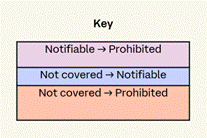
Sector and Technology Changes – Summary Table
To receive the latest insights on US legal developments, subscribe to the Freshfields A Fresh Take Blog.


