

CFIUS 2025 Annual Report – Good Year on Outcomes, Challenging Year on Process
The calendar year 2025 data reported in the recently released annual report by the Committee on Foreign Investment in the United States (“CFIUS” or the “Committee”) reflects a Committee absorbing two shocks at once: a presidential transition and a historic U.S. government funding lapse. Both shocks took a toll on the Committee’s ability to efficiently manage its docket, with case processing metrics regressing, with longer timelines, particularly in connection with cases that required remedies to resolve. With additional government shutdowns potentially on the horizon, investors should work to plan around them, not wait it out.
While review timelines took a hit, outcomes generally were more favorable. CFIUS mitigated roughly 6% of distinct transactions in 2025, and for the second straight year terminated more agreements than it entered into, extending the decline from 2023's peak. The use of short-form declarations hit a record 54% share of distinct transactions, though a rising share are not able to be resolved on the shorter declaration timeline, requiring the declaration to be followed-up with a long-form notice — a sign parties may be over-relying on the short-form track. Enforcement cooled too: site visits to audit compliance with mitigation agreements fell by half and no penalties were disclosed. That said, the report's aggregate metrics provide little context for transaction-specific risks, including politicization, industrial policy considerations, or heightened sensitivity around certain sectors, all of which can materially affect outcomes irrespective of broader trends.
The current Treasury team, under the leadership of a new Assistant Secretary as of this past January, is sending the right signals on building capabilities for more efficient and effective administration of the process, working to refine the Known Investor Pilot Program and develop new technical review capabilities. The question for 2026, however, will be whether the process can overcome the drag of government shutdowns that have affected every transaction over the past 7 months, and withstand risks of politicization of the process in high profile transactions or strategically significant industries.
Note that, to provide more meaningful insight into the data, our analysis adjusts CFIUS's reported statistics to estimate figures on a distinct-transaction basis, correcting to a degree for the double counting inherent in how CFIUS presents its statistics in the annual report.**
Key Takeaways
- Mitigation remains the exception, but the process is under more strain. CFIUS reached a mitigation agreement in roughly 6% of distinct transactions and around 7% of notices in 2025 — broadly in line with recent historical rates — but did so against a backdrop of sharply longer timelines as parties more often had to withdraw/refile in order to reach an agreement, likely due to the transition in administration and extended government shutdown.
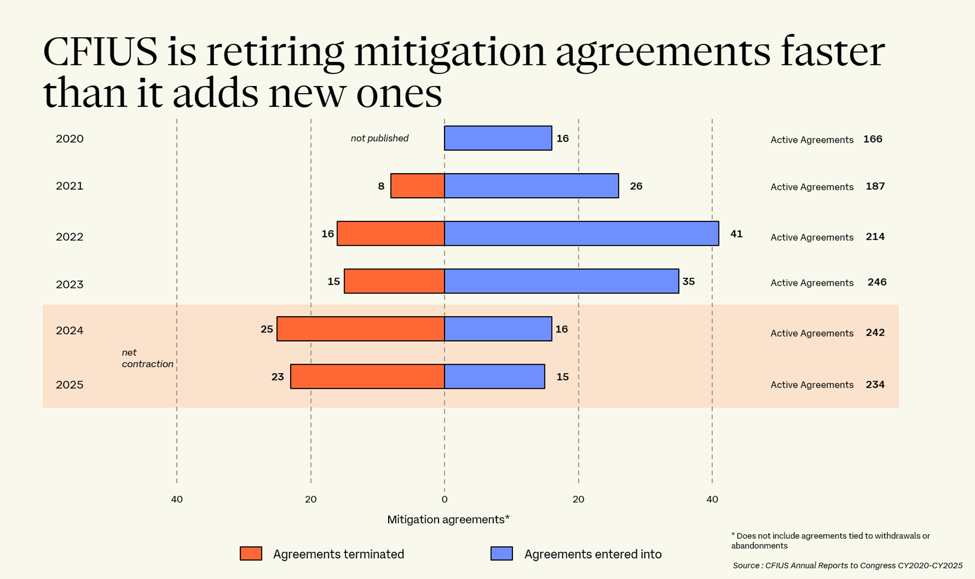
- The stock of mitigation agreements is shrinking for the second year running. Terminations (23) again outpaced new agreements (15), pulling the total agreements under active monitoring down to 234 from a 2023 peak of 246.
- Declarations are being used more, but with mixed results. A record 54% of distinct transactions were filed as short-form Declarations, yet the promise of shorter timelines was not realized as the share of Declarations that ended with CFIUS requesting the parties file a full Notice jumped from 15% to 26% year-over-year — the highest rate since 2022 — indicating some parties are over-estimating their eligibility for the short-form track.
- Processing timelines regressed sharply, driven by the presidential transition and government shutdowns that tolled deadlines (now affecting 6 of the last 10 months); the Committee used its rare 15-day extension authority eight times (presumably to try to resolve matters that could not get across the finish-line within the regular statutory period), versus a total of roughly six uses across the prior seven years combined.
- Chinese filings held steady, but were lower than the perennial investment leaders, Japan and Canada, and a major investor in recent years—the UAE. Though China is reported as filing 33 notices, when adjusting for double-counting, there were no more than 15 and likely even fewer than 10 distinct transactions. These trends are likely to continue, especially given that Chinese M&A activity is lower than any time in the past two decades due to the strategic divide between the U.S. and China and announced UAE commitments to invest $1.4 trillion in the United States over the next 10 years.
- Enforcement posture appears to be softening, at least for now: site visits to test compliance with mitigation measures fell by half (79 to 40) and no monetary penalties were disclosed, even as the Committee issued two formal noncompliance determinations for missed mandatory filings.
Key Action Points for Clients
- Reassess declaration strategy. Declarations remain a good option for straightforward, lower-risk deals involving allied-country investors, but the rising rate of requests for full notices means parties with any meaningful risk profile should weigh filing a notice directly rather than risk losing time to a declaration that turns into a request for a notice.
- Budget for more than one withdraw/refile cycle on remedy-track deals. With the refile-to-remedy ratio now above two, treat a single withdraw/refile as the floor, not the safe zone, when planning the long stop date for a deal likely to require mitigation.
- Build in buffer for further funding lapses. With continuing impact from the record shutdown earlier this year and any September continuing resolution likely only extending funding into early-to-mid December, parties should factor shutdown risk into closing schedules.
- Front-load your advocacy. A meaningful share of transactions that reach investigation still result in a remedy, so the pre-filing and phase one review periods are the highest-value windows to anticipate and address CFIUS's concerns directly.
- Existing national security agreement holders should engage proactively. With terminations now outpacing new mitigation agreements for the second consecutive year, parties under an existing agreement have a real opening to approach their monitoring agency about whether continued mitigation is still warranted, or whether targeted modifications are justified based on experience under the agreement.
- Watch the enforcement and policy signals into 2026 — the trajectory of site visits, noncompliance determinations, and penalties, together with how the Known Investor Pilot Program and the new Office of Research and Analysis are used, will be the clearest early indicators of how the administration intends to run the program going forward.
IN-DEPTH ANALYSIS
I. Declarations are up, but more ended with a request for a full notice.
What the data shows:
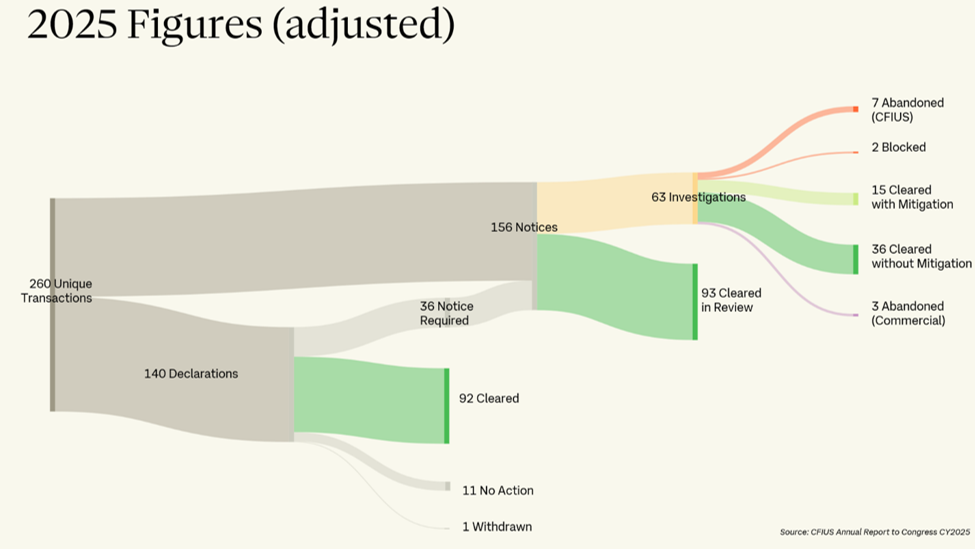
- Declarations rose approximately 21%, up from 116 to 140. On an adjusted basis, 54% of distinct transactions were filed as declarations, up from 44% in 2024 and 39% in 2023. That is the highest share since the process was introduced.
- That said, CFIUS did not simply wave them through. 36 declarations (26%) ended in a request to file a notice, up from 15% in 2024 and the highest rate since 2022. A further 11 (8%) ended with CFIUS unable to conclude action.
What the data means:
- The increase in the percentage of declarations after which CFIUS requested a full notice does not necessarily mean that CFIUS is less efficient or changed its approach. It is more likely reflective of transaction parties being overly bullish on declarations, resulting in transactions that should have been filed as notices being filed as declarations.
Looking ahead:
- File a notice rather than a declaration in most cases where there is any plausible risk. We expect submission of declarations to remain a viable option for allied-country investors in low-risk deals, but transaction parties should carefully assess both timing risk and odds of a successful outcome before choosing to file a declaration with CFIUS. Parties weighing real substantive risk should consider filing a notice in the first instance, particularly given that the average time simply to have a declaration accepted rose from 4.2 to 6.87 days.
II. Withdraw-and-refile trends: Significant drag for transactions requiring a remedy
What the data shows:
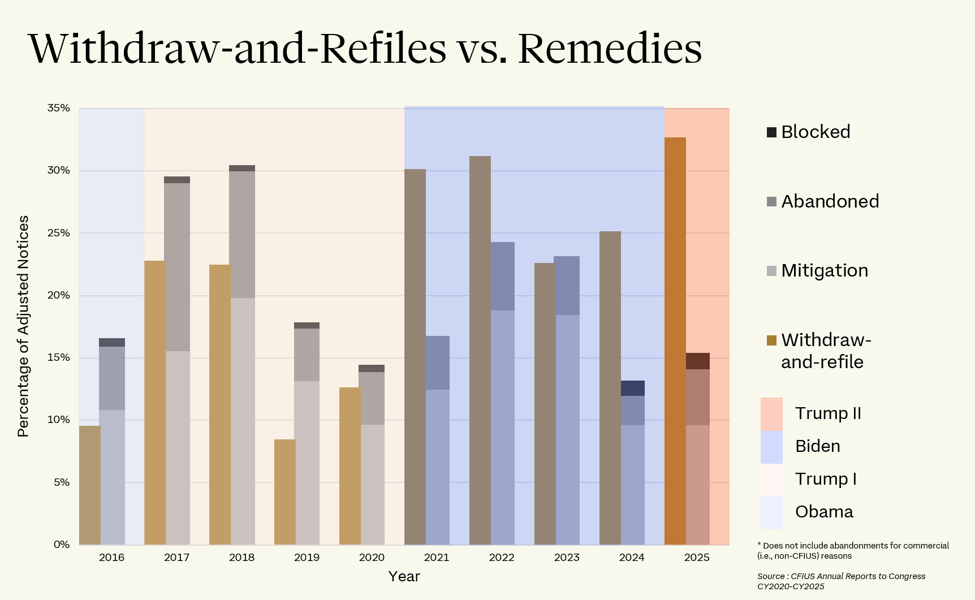
- The annual report states that of 207 notices filed, 61 were withdrawn. Parties refiled 51 of those notices (37 refiled within 2025 and 14 in 2026), abandoned 7 transactions due to concerns raised by CFIUS, and abandoned 3 transactions for commercial reasons.
- CFIUS cleared 15 transactions after requiring parties to execute a mitigation agreement, parties abandoned 7 transactions due to CFIUS national security concerns without a presidential order, and the President issued 2 prohibition orders, for a total of 24 (15%) of distinct transactions filed with notices, ending with a remedy.
- The number of withdraw/refiles, therefore, significantly exceeds the number of transactions that required a remedy. Transactions requiring a remedy were withdrawn-and-refiled an average of 2.13 times.
- Many of those refilings were likely Chinese investors, who accounted for 33 notices but under 15 distinct transactions, meaning most Chinese transactions were withdrawn-and-refiled at least once.
- CFIUS has the ability to extend the 90-day review and investigation period by 15 days in “extraordinary circumstances.” CFIUS exercised this authority 8 times in 2025; it exercised it only 6 times in total from 2018 through 2024.
What the data means:
- A withdraw/refile is prompted by a need for additional time, sometimes needed by CFIUS to complete its analysis and sometimes needed by parties to react to remedies proposed by CFIUS.
- A healthy CFIUS process should see the number of withdraw/refiles trail the number of remedies, not outpace them. Ideally CFIUS flags a proposed remedy early enough in the investigation period to leave room for negotiation without needing to reset the clock; withdraw/refile (especially after the 2018 law extended the CFIUS process from 75 to 90 days) should be necessary only in cases with exceptionally complex national security risks that end with prohibitions or complex mitigation agreements. That dynamic held under the first Trump administration, where the withdraw/refile rate (0.71 refiles per remedy, meaning most remedy cases cleared on the first filing) trailed remedy activity — but it inverted sharply under Biden (1.40), and the 2025 rate of 2.13 is high enough to suggest more than routine friction.
- Some portion of the uptick is likely attributable to the presidential transition year. The 2025 uptick continues a pattern seen at every recent change in administration, with delays resulting from newly confirmed officials getting pulled into case decisions late in the process and resolution in some cases requiring higher level signoff until Assistant Secretary-level vacancies are filled.
- The rest is likely a shutdown-driven backlog. The 2025 lapse in appropriations tolled statutory CFIUS deadlines for 43 days — over 20% longer than the 2018–2019 shutdown.
Looking ahead:
- Build in real buffer for shutdown-driven tolling, given current divisions in Congress. The Committee tolled deadlines for over 120 cumulative days in the past 10 months, and we are still experiencing significant after-effects of the most recent shutdown. The House and Senate have passed differing continuing resolutions, so a shutdown in October remains possible. Even if they come to agreement, that would create another potential shutdown risk in December. It is all but certain that the withdraw/refile rate will stay elevated, if not worsen, in the 2026 Annual Report.
- Plan for multiple withdraw/refile cycles on any remedy-track deal, not just one. At an average withdraw/refile-to-remedy rate of 1.4 during the Biden term, parties already should have planned on at least one withdraw/refile for any transaction that could draw mitigation. With that average jumping to 2.13 in 2025, parties should consider whether the nature of the potential concerns warrants adding yet another three months to the total timeline, bringing the total to almost 11 months from signing for the most complex deals. The current Treasury leadership team has focused on building process efficiencies, such as an internal “shot clock” and various other tools as described in the last section below. While this may have some benefit, it risks being completely overtaken by shutdown-related delays, especially if CFIUS takes the view, as it did (some would argue unnecessarily) during the extended shutdown earlier this year, that it will not initiate new reviews during a shutdown even if it has the capacity to do so.
- The faster pre-filing process doesn't offset the rising number of cycles per remedy case. Pre-acceptance processing time has roughly halved since 2019 (from about 18 business days to about 8.8), but if that time is now being spent multiple times per remedy case rather than once, remedy-track transactions can still take longer overall than the per-cycle efficiency gains suggest.
III. CFIUS uses mitigation more sparingly while also terminating many existing agreements
What the data shows:
- CFIUS cleared transactions after requiring parties to execute a mitigation agreement in 15 cases, or 10% of adjusted notices and under 6% of all transactions (i.e., including transactions filed as notices or declarations), which is lower than the average rate in the first Trump term (14.6% and 12.9%) and the Biden term (15.1% and 9.8%).
- 38% of distinct transactions that went to investigation ended with a remedy, up from 30% in 2024 but well below the 52% to 56% recorded in 2021 through 2023.
- CFIUS also adopted mitigation agreements to address residual concerns with respect to 2 transactions that were withdrawn and abandoned, imposed conditions in Treasury's withdrawal letters on a further 5, and imposed interim risk measures in 2 cases (most likely for the post-closing prohibitions by President Trump involving Suirui’s acquisition of Jupiter Systems and HieFo Corporation’s acquisition of EMCORE Corporation’s digital chip assets).
- Notably, CFIUS terminated 23 mitigation agreements in 2025. This is, therefore, the second consecutive year of net decrease in overall mitigation agreements, and the overall number of mitigation agreements in place has fallen from a peak of 246 at the end of 2023 to 242 and now 234. Before 2024 it had grown every year for which data is published, from 166 at the end of 2020.
What the data means:
- The rate of mitigation continues to trend favorably. This is likely in part because CFIUS is not seeking supply assurances in many instances now where it might have reflexively done so in the past where there are government customers, even if the transaction did not reasonably place that supply in potential jeopardy.
- Going to investigation does not necessarily mean that CFIUS will seek a remedy, but the likelihood remains significant.
- CFIUS’s mitigation monitoring function is actively reviewing transactions to assess whether the risk justifying the mitigation no longer exists, which is a sign of a maturing enforcement function.
Looking ahead:
- It is as important as ever to focus on making your case in the notice and during review period, before the investigation phase. The fact that 38% of transactions that go to investigation result in a remedy underscores the importance of anticipating potential areas of concern and addressing them in the notice or during the review period, whether by speaking to those concerns directly or by ensuring that CFIUS requests for information are answered with a view to making sure that CFIUS has all relevant context necessary to accurately understand the facts on the ground.
- Parties should consider whether relief from mitigation is warranted. For companies living under a national security agreement, the rate of termination of agreements suggests that parties should actively consider whether to approach the monitoring agencies if they think the need for the mitigation may have abated or if there are modifications that may be justified based on learned experience that may reduce pain points. For more details, please see our analysis of the issue at After the mitigation boom: The case for ending zombie CFIUS agreements | Freshfields.
IV. Policy developments worth noting
The 2025 Report devotes more space than usual to qualitative updates. Four points for investors to watch:
- Known Investor Pilot Program. Launched in 2025 to implement the America First Investment Policy (“AFIP”)'s fast track commitment, the pilot collects detailed information from foreign investors in advance of any filing. We remain skeptical that the Known Investor Program, without significant rethinking, will offer benefits. See our analysis at: CFIUS: Is the Known Investor Program the golden ticket for investors? | Freshfields
- Office of Research and Analysis. Within Treasury's Office of Investment Security, this new “in-house technical branch” will be staffed by scientists, engineers and data specialists, who presumably will bring some much-needed technical expertise to reviews.
- Public Engagement: The Administration continues to emphasize their desire to engage directly with investment, business and academic leaders to address process concerns and stay ahead on potential substantive risks.
- Enforcement Posture: Treasury disclosed only two determinations of non-compliance for the year (both for missed mandatory filings). This points to a less aggressive enforcement posture and a possible pivot toward encouraging voluntary compliance rather than penalties. The trajectory of site visits, non-compliance determinations, and penalties over the next few years will be worth monitoring for signs of how the Trump administration intends to approach enforcement.
** Following is the methodology that we have adopted in this analysis to identify “distinct” transactions: If a declaration resulted in a request for a notice, the declaration and notice are treated as a single distinct transaction. If a notice was withdrawn-and-refiled, the initial notice and the refiled notice are treated as a single distinct transaction. As a very small number of transactions may have been withdrawn-and-refiled more than once, the methodology does not eliminate all double counting.
To receive the latest insights on US legal developments, subscribe to the Freshfields A Fresh Take Blog.


