

“Retroactive” dividend entitlement under authorised capital: Can the permitted become prohibited?
The Higher Regional Court of Munich has refused to register a capital increase from authorised capital with a simplified exclusion of subscription rights. It did not identify a single breach of law. Instead, it relied on the “cumulative effect” of eight factors. The reasoning is unconvincing, but it puts pressure on one of the most important equity financing tools available to listed companies: the 10% (since 2024: 20%) capital increase with a simplified exclusion of subscription rights. A few targeted measures can restore much of the transaction certainty that the decision has called into question.
In its decision of 28 May 2026 (31 Wx 82/26 e), the Munich court addressed a question of considerable practical relevance. We analyse it in detail in the Neue Zeitschrift für Gesellschaftsrecht (NZG 2026, 1269–1276). This post summarises our key findings and focuses on what issuers can do now.
The case
A Munich-based SE whose shares were traded on the open market (Freiverkehr) used its authorised capital in January 2026. With the approval of the supervisory board, the management board increased the share capital by 10% against cash contributions. It excluded shareholders’ subscription rights under the simplified regime of Section 186(3) sentence 4 of the German Stock Corporation Act (AktG). The new shares were to carry dividend rights from 1 January 2025, and therefore for a financial year that had already ended. The company’s articles of association expressly permitted this, including for shares issued from authorised capital.
Both the commercial register court and the Higher Regional Court refused registration. The consequences were severe. The company had to repay almost EUR 480,000 to subscribers, and insolvency proceedings were opened a little over four weeks after the decision. One further detail stands out: in June 2023, the same register court had registered an almost identical capital increase by the same company without objection.
Eight factors, no breach of law
The court did not decide the core question: may the management board, when excluding subscription rights, grant new shares a dividend entitlement for the financial year just ended? Instead, it relied on an overall assessment. According to the court, all factors taken together precluded registration, “irrespective of whether individual measures were resolved in a permissible manner” (our translation). The factors include:
- the dividend entitlement for a financial year that had already ended;
- the complete exclusion of subscription rights;
- the absence of “protective or compensatory arrangements” for existing shareholders;
- insolvency and litigation risks in enforcing damages claims;
- the imminent expiry of the five-year authorisation;
- the full use of the statutory ceiling of 50% of the share capital;
- the possibility of using the authorisation several times; and
- the absence of reasoning on the exclusion of subscription rights in the management board resolution.
In our view, each of these elements is lawful in its own right:
- Dividend entitlement: Section 60(3) AktG leaves the allocation of profits to the articles of association. Shareholders’ claim to a dividend only arises once the general meeting resolves on the appropriation of profits (Section 174 AktG). Until then, the balance sheet profit is merely an accounting figure. Anyone who becomes a shareholder before that resolution shares in the distribution without encroaching on an existing right. This is also why “retroactive” belongs in inverted commas.
- Exclusion of subscription rights: An exclusion under Section 186(3) sentence 4 AktG requires no separate substantive justification. The legislator has already struck the balance.
- Term, ceiling, repeated use: These factors concern the general meeting’s authorisation resolution, not the capital increase filed for registration. A statutory ceiling marks the limit of what is permitted. Reaching it is not a ground for suspicion.
The fundamental objection runs deeper: lawfulness is not a matter of degree and cannot be added up. Combining permitted arrangements yields more permitted arrangements, not an unlawful one. Stock corporation law does provide correctives for abuse: the principle of equal treatment, the duties of the management and supervisory boards, and the prohibition of abuse of rights. Each of them, however, requires a specific finding. The court made none.
Why it matters: the issuance window
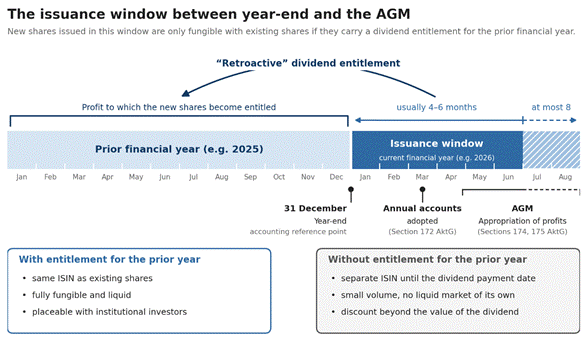
Accelerated bookbuildings with a simplified exclusion of subscription rights are the most important tool for raising equity at short notice. A key window for these transactions opens when the financial year ends and closes when the annual general meeting resolves on the appropriation of profits. The general meeting must take place within the first eight months of the financial year (Section 175(1) sentence 2 AktG). In practice, it is usually held four to six months after year-end.
New shares issued during this window only carry the same rights as the existing shares if they are also entitled to the profit of the previous financial year. Without that entitlement:
- Separate ISIN: The new shares need their own ISIN until the dividend payment date.
- No fungibility: Their volume is small compared with the existing shares (up to 10%, or 20% where the options under the Future Financing Act are used). No liquid market of their own can develop.
- Difficult placement: Investors are generally reluctant to buy non-fungible shares, if they buy them at all.
- Discount: Where placement succeeds, the resulting price differences go beyond the value of the dividend and reflect a discount for lack of liquidity.
This is why the “retroactive” dividend entitlement is market standard. 147 of the 150 companies in the DAX family provide for it in their articles of association. Taken to its logical conclusion, the court’s approach would make capital increases with an exclusion of subscription rights practically impossible in the first months of every financial year.
How far does the decision reach?
The practical impact is likely to be smaller than it first appears. The court itself describes its ruling as a decision on the individual case, and several of the factors it relied on are specific to the facts. Had an otherwise identical capital increase been the first use of the authorisation, or taken place in the first half of its term, the court’s reasoning would probably not have applied. The same is likely to be true where the management board resolution sets out its reasons for excluding subscription rights.
The real damage therefore lies less in the decision’s reach than in the legal uncertainty it creates. An issuer that needs to act within a window of a few days cannot rely on a “probably not applicable”. Clarification by the Federal Court of Justice is not in sight, because the court did not allow an appeal on points of law.
Transaction certainty: what issuers should do now
Until the Federal Court of Justice decides the issue, we recommend four precautionary measures. None of them concedes that the court’s approach is correct.
1. State the reasons in the management board resolution
The resolution filed with the commercial register should set out the key substantive reasons for excluding subscription rights. It should also weigh them against the interests of existing shareholders. This matters most where the new shares carry a dividend entitlement for the previous year. The resolution should address the alternative, a separate ISIN with the disadvantages for fungibility and liquidity described above, and state expressly that it is not a practicable option. We do not consider this a legal requirement. It does, however, remove the basis for the objection that reasoning was missing.
2. Engage with the register court early
Where the facts come close to the Munich case, issuers should discuss the planned transaction with the competent register court in advance. Early contact is advisable in most other cases as well, if only to align on the timetable through to registration.
3. Settle the dividend entitlement in the authorisation itself
The general meeting can determine the dividend entitlement of the new shares when it creates the authorised capital. The decision then no longer lies within the management board’s discretion. A possible wording (in translation):
“The new shares participate in profits from the beginning of a financial year that has already ended, provided the general meeting has not yet resolved on the appropriation of the balance sheet profit for that financial year.”
The price is a loss of flexibility in the individual case.
4. Keep the authorisation current
On the court’s reasoning, it weighed against the company that the authorisation had already been used and was close to expiry. Issuers that renew their authorised capital regularly deprive these factors of their weight from the outset. The coming AGM season is a good opportunity to review existing authorisations. Ideally, the capital increase should also be registered before the general meeting resolves on the appropriation of profits.
Outlook
The Munich court has raised a question of great practical importance without answering it. Until the Federal Court of Justice provides clarity, transaction certainty is in the hands of issuers and their advisers. Careful documentation, a forward-looking authorisation and early contact with the register court will keep the spring issuance window open.
To receive the latest insights on transactions and deal-making, subscribe to the Freshfields Transactions Blog.