

Three years into the UPC: The Hague takes the lead in pharmaceutical patent litigation
Three years after the Unified Patent Court opened its doors, pharmaceutical patent litigation has become an increasingly visible part of the UPC landscape. And one venue stands out: around a quarter of the pharmaceutical patent cases have been brought before the Local Division The Hague. More than before any other Division. That may not be surprising when two of its legally qualified judges are graduated biochemists.
The numbers
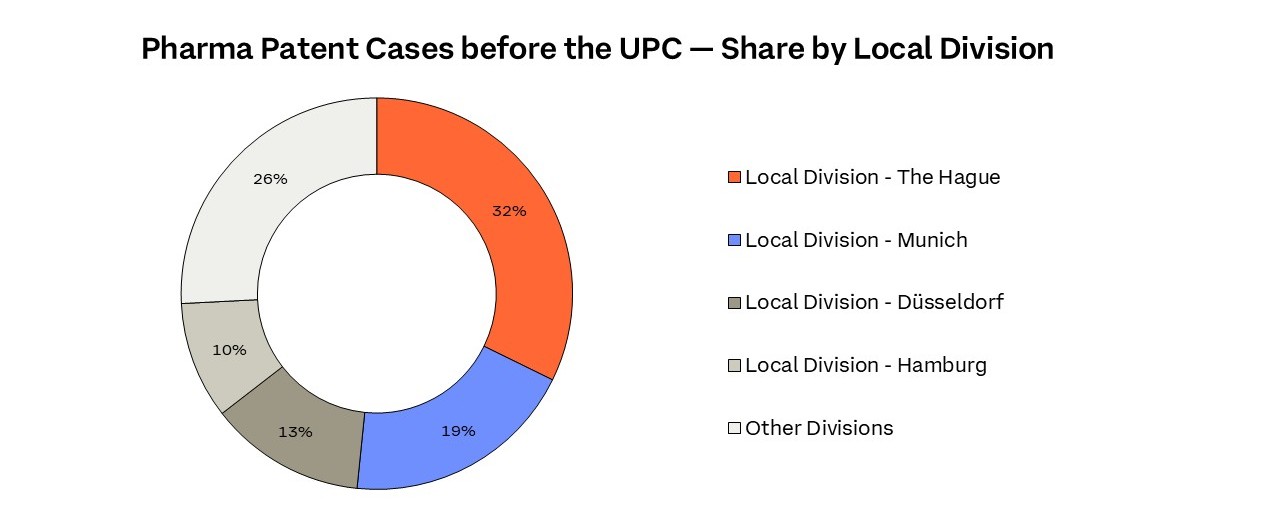
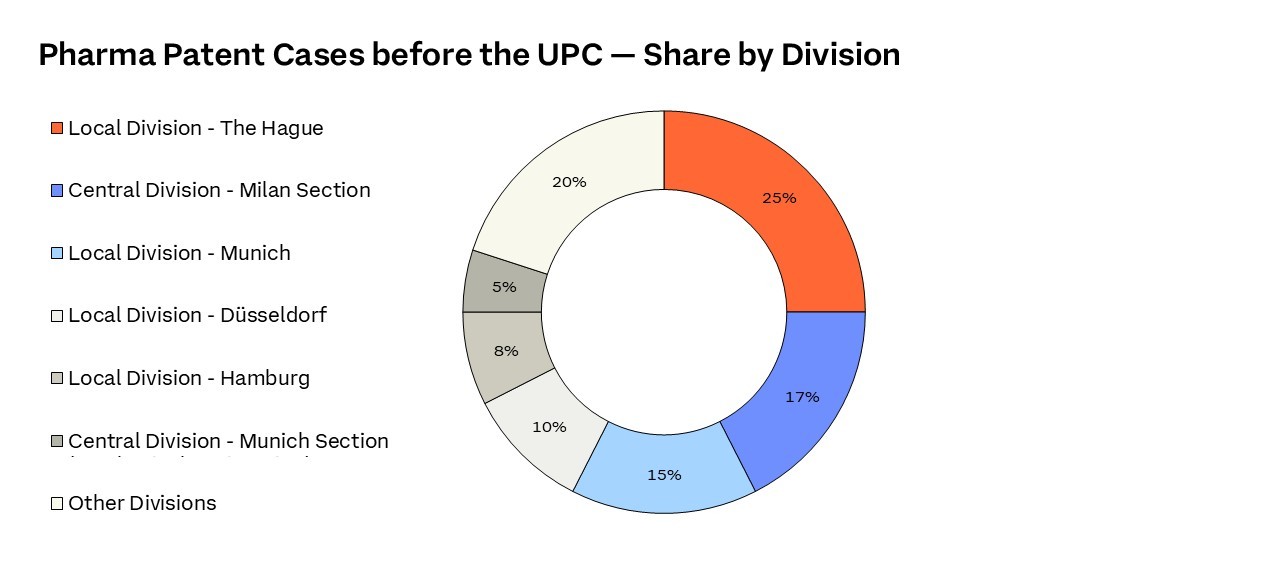
Pharmaceutical patent litigation at the UPC has started more cautiously than litigation in other sectors. While healthcare already accounts for more than 20% of first-instance UPC filings and close to half of applications for preliminary injunctions, those figures include medical devices. Looking specifically at pharmaceutical patent disputes, the distribution between the UPC's divisions shows a clear picture:
Methodology: Data compiled from the UPC public court register, supplemented by DartsIP, Pierre Véron's case law database, HOYNG ROKH MONEGIER's UPC Intelligence and JUVE Patent reporting. It covers the period from the UPC's opening on 1 June 2023 to 14 August 2026, and includes both ongoing and concluded disputes. We included patents on active pharmaceutical ingredients, manufacturing processes, (second) medical use claims and formulations. We excluded medical devices and general chemical inventions.
Looking only at the Local and Regional Divisions, The Hague accounts for roughly one in three pharmaceutical cases. Even when including the Milan Central Division, the Hague still leads with a quarter of all UPC pharmaceutical patent cases. The Milan central division comes second at around 17%, followed by the Local Division Munich at 15% and the Local Division Düsseldorf at 10%.
The Hague is not the UPC's largest division by volume. Following the UPC’s monthly reports, in Munich, Düsseldorf and Mannheim there were all filed more first-instance cases than in The Hague. The Hague sits fourth, at roughly 12% of filings, yet it takes a quarter of the pharmaceutical work, roughly double its share of the court's overall caseload.
Defining UPC pharma cases
Despite the relative low number of pharmaceutical cases, they have already contributed significantly to the UPC's developing case law.
In Sanofi v Amgen, the Court of Appeal provided important guidance on inventive step, developing an approach to obviousness that differs in certain respects from the EPO's established problem-solution approach.
Pharma cases have also been central to the law on preliminary injunctions and imminent infringement. Novartis v Celltrion and Boehringer Ingelheim v Zentiva show an increasingly fact-sensitive approach. The UPC looks closely at where a generic or biosimilar sits on the regulatory and commercial path to market, when it has effectively “set the stage” for launch, and when infringement has become sufficiently concrete for the patentee to be expected to act.
In Merz v Viatris, the UPC Court of Appeal has showed that in the SPC context the court takes account of the national regulatory and reimbursement framework when assessing both imminence and whether a patentee has waited too long before seeking provisional relief.
On second medical use patents, the UPC has rejected a one-size-fits-all infringement test. In Sanofi/Regeneron v Amgen, it held that the court must consider all relevant circumstances, including how the medicinal product is marketed, the information provided to prescribers and whether the alleged infringer knew or should have known that this could lead to the patented therapeutic use.
Other pharma-relevant questions remain open, including whether the UPC can grant Arrow declarations. Requests for one have already been filed, but the court has not yet ruled on it.
Cross-border potential
The cross-border reach at the UPC cuts both ways: a single action can secure a patentee pan-European relief, or expose a manufacturer to pan-European liability. After the CJEU's judgment in BSH v Electrolux, the scope for cross-border patent enforcement in Europe widened. The Court of Appeal's decision in Fujifilm v Kodak added to that picture, addressing the UPC's jurisdiction over European patent designations outside the UPC territory (see our full blog here). A single dispute can now have consequences well beyond the UPC’s territorial borders.
In pharma disputes the UPC's cross-border evidence-gathering powers can prove to be a powerful tool. Genentech/Roche v Organon illustrates how evidence-preservation and inspection measures can be particularly valuable where information about a pharmaceutical product or manufacturing process is not publicly available.
What comes next?
The volume of pharmaceutical litigation will only increase. Three years in, the UPC is no longer an experiment. For pharmaceutical patent litigation in particular, The Hague has emerged as one of its key venues, and its importance is likely to grow further.

